






If you are feeling anxious,
panicked, or on edge
Your nervous system is in a protective, high-alert state. These techniques signal safety to your body.
Physiological Sigh
Polyvagal / Respiratory Research
- Take a full inhale through your nose.
- At the top, take a second short sniff to fully expand your lungs.
- Release a long, slow exhale through your mouth until your lungs are empty.
- Repeat 1 to 3 times. Notice any shift in your body.
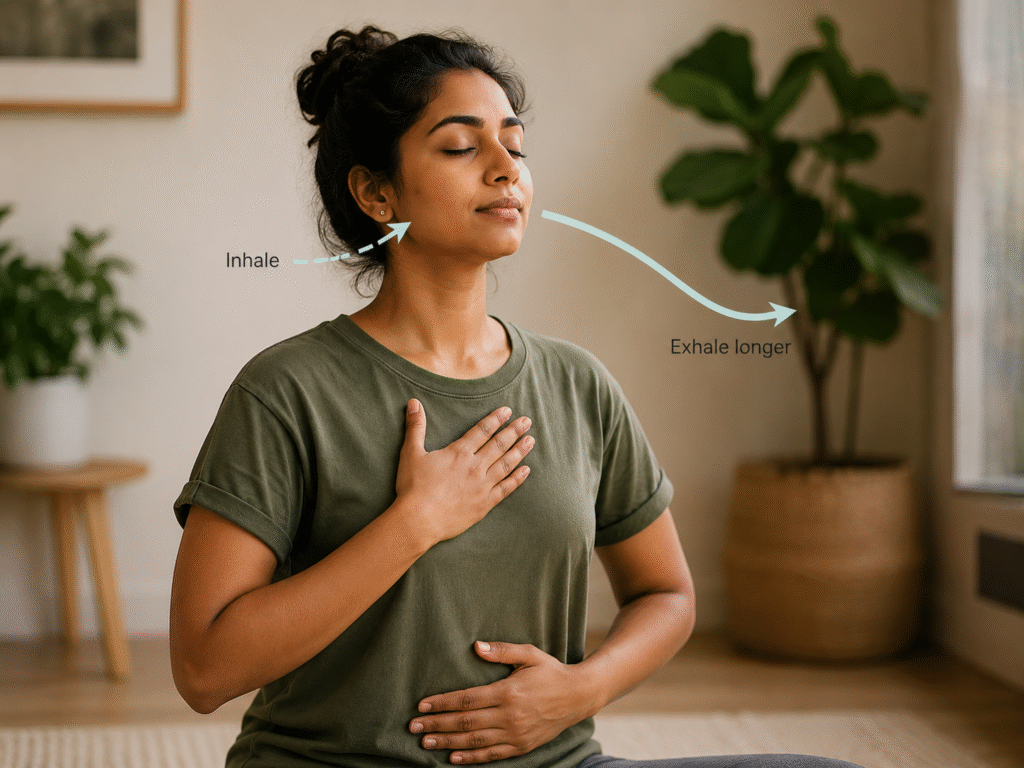
Extended Exhale Breathing
Polyvagal Theory
- Inhale for 4 counts through your nose.
- Hold gently for 1 to 2 counts.
- Exhale slowly for 6 to 8 counts through your mouth.
- The longer exhale activates the vagal brake and slows your heart rate.
- Repeat for 5 to 10 cycles.
Cold Water Reset
Somatic / Autonomic Regulation
- Run cold water over your wrists and inside of your forearms for 30 seconds.
- Alternatively, splash cold water on your face.
- This activates the dive reflex and slows your heart rate quickly.
- Follow with 3 slow breaths.
Bilateral Tapping
EMDR / Somatic
- Cross your arms over your chest, hands resting near your shoulders.
- Alternate tapping left, right, left, right at a slow, steady rhythm.
- Focus on your breath while tapping for 30 to 60 seconds.
- This bilateral stimulation supports nervous system calming.
If you are feeling flooded, overstimulated, or cannot think clearly
When there is too much coming in at once, these techniques help you find the edge of your window of tolerance.
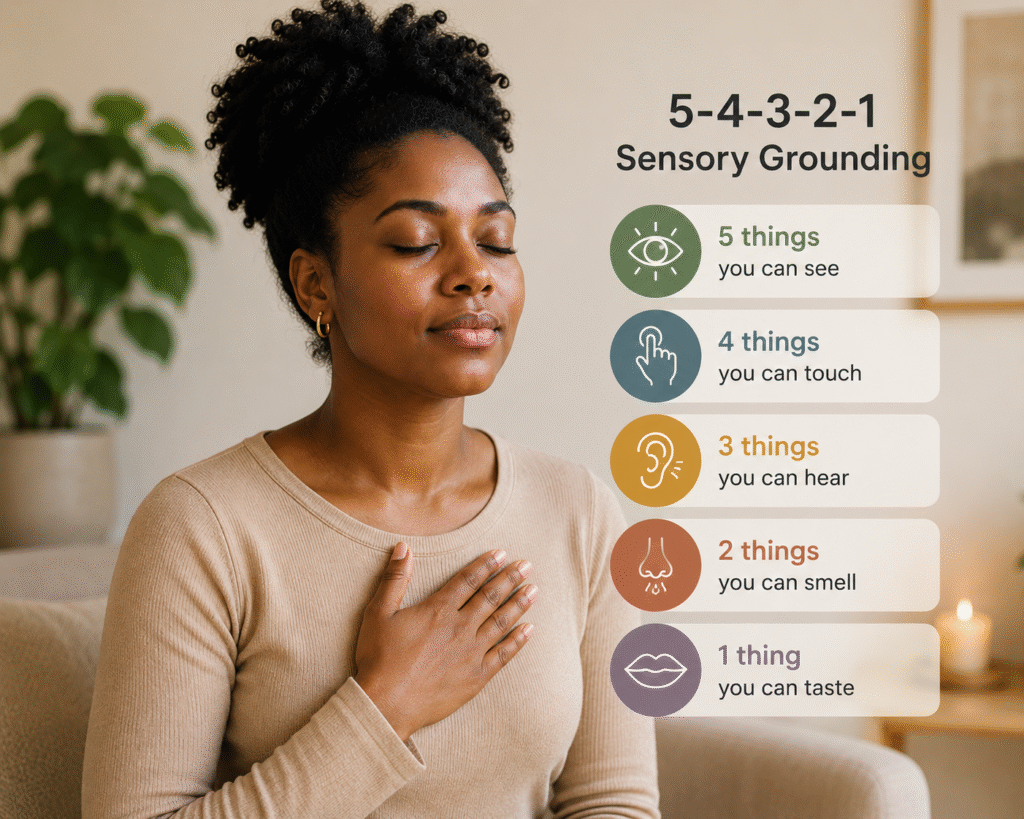
5-4-3-2-1 Sensory Grounding
Cognitive Behavioral / Somatic
- Name 5 things you can see right now.
- Name 4 things you can physically feel (floor, chair, clothing).
- Name 3 things you can hear.
- Name 2 things you can smell.
- Name 1 thing you can taste. Slow down between each one.
Containment Visualization
EMDR / IFS-Informed
- Close your eyes and imagine a container, any kind that feels secure to you.
- Mentally place whatever feels too big right now inside it.
- See yourself closing and securing the container.
- It is not gone. It is held safely until you are ready.
- Take 3 slow breaths.
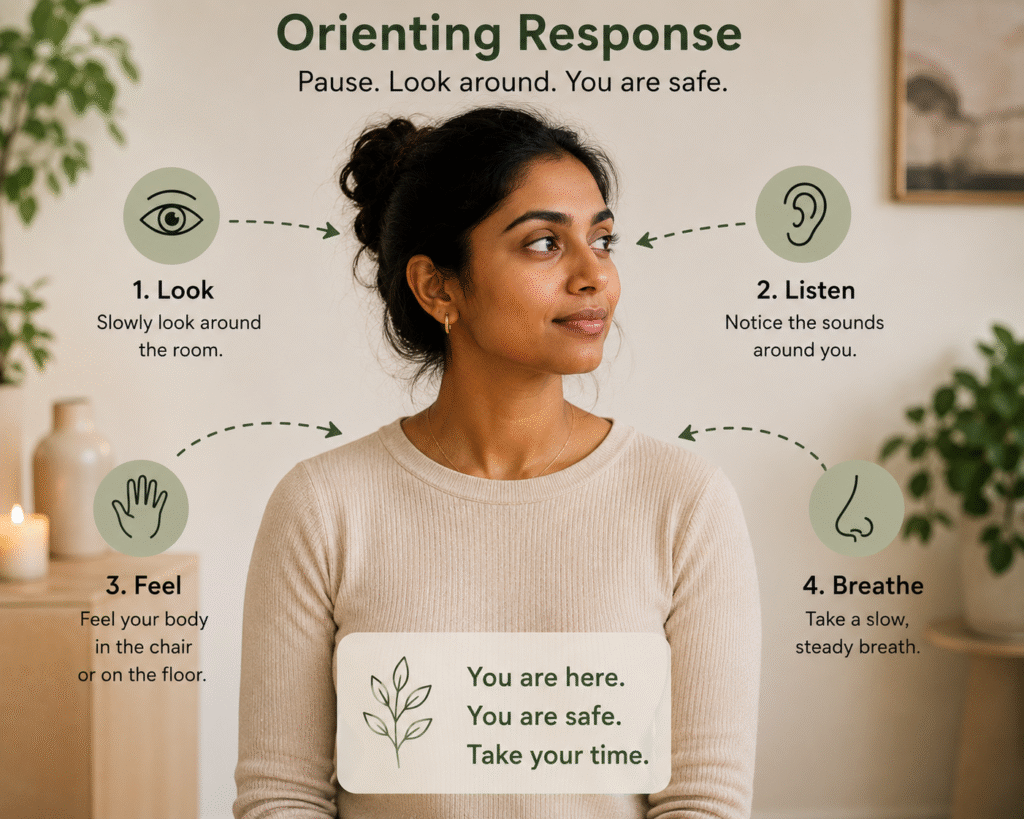
Orienting Response
Somatic Experiencing / Polyvagal Theory
- Sit comfortably and let your eyes soften, without staring.
- Slowly turn your head left and right, allowing your gaze to move naturally.
- Let your eyes settle on something that feels neutral or pleasant.
- Rest there for a moment. Notice what it feels like to be here, in this room.
If you feel detached, foggy,
unreal, or numb
Dissociation is a protective response. These techniques gently bring you back into your body and the
present moment.
Somatic / Grounding
Feet on the Floor

Remove your shoes if possible and place both feet flat on the floor.

Press down firmly. Feel the ground pushing back.

Slowly rock your weight forward and backward, then side to side.

Say quietly: I am here. This is now. I am safe in this moment.
Somatic Experiencing
Strong Sensory Anchor

Hold something with strong texture, temperature, or weight (ice, a stone, a textured fabric).

Focus entirely on the physical sensation for 30 to 60 seconds.

Describe the sensation out loud or silently in detail.

This interrupts the dissociative state with direct sensory input.
EMDR / Ego State Therapy
Safe Place Visualization

Bring to mind a place, real or imagined, where you feel completely safe.

Notice what you see, hear, smell, and feel in that place.

Let yourself rest there for 1 to 2 minutes.

Place one hand on your heart and breathe slowly while you are there.

If you feel shut down, frozen, exhausted, or unable to move
Shutdown is your nervous system's deepest protective state. These techniques use gentle activation to help you come back online.
Valsalva Maneuver (Gentle)
Polyvagal / Autonomic Regulation
- Take a medium inhale and hold it.
- Gently bear down as if you are about to do something effortful, without straining.
- Hold for 5 to 10 seconds, then release and exhale.
- This stimulates the vagus nerve and can shift a collapsed state.
- Repeat 2 to 3 times.
Activating Movement
Somatic Experiencing / NARM
- Start small: wiggle your fingers and toes.
- Add movement: roll your shoulders, shake your hands gently.
- If able, stand and slowly shift your weight from foot to foot.
- Notice any warmth, tingling, or aliveness returning to your body.
- Follow the energy where it wants to go.
Humming or Toning
Polyvagal Theory
- Take a comfortable breath in.
- Exhale while humming any tone for as long as feels comfortable.
- Feel the vibration in your chest and throat.
- Humming stimulates the vagal nerve through vibration of the vocal cords.
- Repeat for 5 or more breaths.
If you are feeling low, hopeless, heavy, or disconnected from yourself
These practices gently support reconnection, not to fix or force, but to resource and restore.
Mindful Self-Compassion (Neff)
Self-Compassion Pause

Place one hand on your heart. Take a slow breath.

Acknowledge what is hard: This is a moment of suffering.

Remind yourself: I am not alone in this. Others feel this too.

Ask: What do I need right now? Offer it to yourself gently.
Behavioral Activation
Sunlight and Movement Micro-Dose

Step outside or sit near a window for 5 to 10 minutes.

Let natural light reach your eyes without looking directly at the sun.

Add slow, gentle movement if possible: a short walk, stretching, swaying.

This supports circadian rhythm regulation and dopamine activity.
NARM / Somatic
Resourcing: What is Working

Identify one small thing that is working in your life right now, no matter how small.

Let yourself stay with it for a moment. Notice where you feel it in your body.

This is not about minimizing pain. It is about expanding the picture.

Breathe into that felt sense for 1 to 2 minutes.
A Note from Our Practice
These resources are offered as tools for support between sessions or before you begin therapy. They are not a substitute for clinical care. If you are experiencing a mental health crisis, please contact the 988 Suicide and Crisis Lifeline by calling or texting 988. If you are ready to begin working with one of our therapists, we welcome you to Get Started using the link at the top of our website.